If you have ever walked through Barcelona’s Eixample and looked down, you have seen it. Perhaps without noticing it. Perhaps without knowing it has a name, a history and an author. That small hexagonal cement tile that covers kilometres of pavement in the city is the
Panot de Barcelona, and it has far more to tell than it might seem at first glance. So much so that at Ferrer Wines we have built an entire collection of cavas around it.
A city that takes care of its streets
Barcelona has a habit of taking care of details. Not just the big ones, the ones that appear in tourist guides and Instagram photos. Also the small ones, the ones that are there every day for anyone who wants to see them. The lamp posts of Passeig de Gràcia, the undulating benches of Park Güell, the tiles on the houses of the Eixample. And the pavement.
The streets of Barcelona are, in many ways, an open-air museum. A museum you walk on, move through, and live in. And the panot is its most reproduced, most widespread and possibly most beloved piece. There is something very Barcelonian about that: turning something as functional as a pavement tile into a cultural symbol recognised all over the world.
From one street to an entire city
What began as a one-off commission for Passeig de Gràcia ended up becoming the official pavement of the entire Eixample. That fact, seemingly administrative, has an enormous consequence: the panot stopped being an architectural curiosity and became the floor of a whole city.
Today the Eixample is one of the densest and most trafficked neighbourhoods in Europe. Its pavements support millions of people every day: residents, workers, tourists, delivery riders, students. All of them, without exception, walk on the same design that Gaudí conceived more than a hundred years ago. That continuity is almost miraculous. And it is also deeply Barcelonian.
Because Barcelona is a city with the rare ability to integrate its past into its present without it feeling forced. The panot is not a monument you have to approach with reverence. It is the floor. It is the most everyday thing there is. And yet, when someone from outside sees it for the first time, they recognise it immediately as something belonging to this city and no other.
Why the panot has become a symbol
There is a paradox at the heart of the panot as a symbol: the more it is used, the more it is ignored. Barcelonians walk on it every day without thinking about it. It is so integrated into the everyday landscape that it becomes invisible, like the colour of your walls or the sound of your building’s lift. And yet, when someone points it out to you, when someone explains where it comes from and who designed it, something changes. You can no longer look at it the same way.
That is what good symbols do. They do not impose their meaning. They keep it, silent, until someone takes the time to discover it. And then, suddenly, something that was always there takes on a weight and a presence it did not have before.
The panot has completed that journey. It has gone from being a pavement tile to appearing on postcards, T-shirts, decorative tiles and all kinds of souvenirs. It has crossed borders and become one of the most recognisable mementos of Barcelona. But its true power remains the same as always: it is in the street, free, available to anyone who wants to look at it.
The collection born from that symbol
When at Ferrer Wines we started thinking about a cava collection with its own identity, the panot did not take long to appear. Not as a whim, but as an obvious choice. Cavas Hill, the winery that produces these cavas, has been in the Alt Penedès since 1887. Barcelona and the Penedès have been neighbours, partners and mirrors of each other for centuries. The city that consumes and the land that produces. The modernisme that flourishes in the streets and the viticulture that works in silence less than an hour away by car.
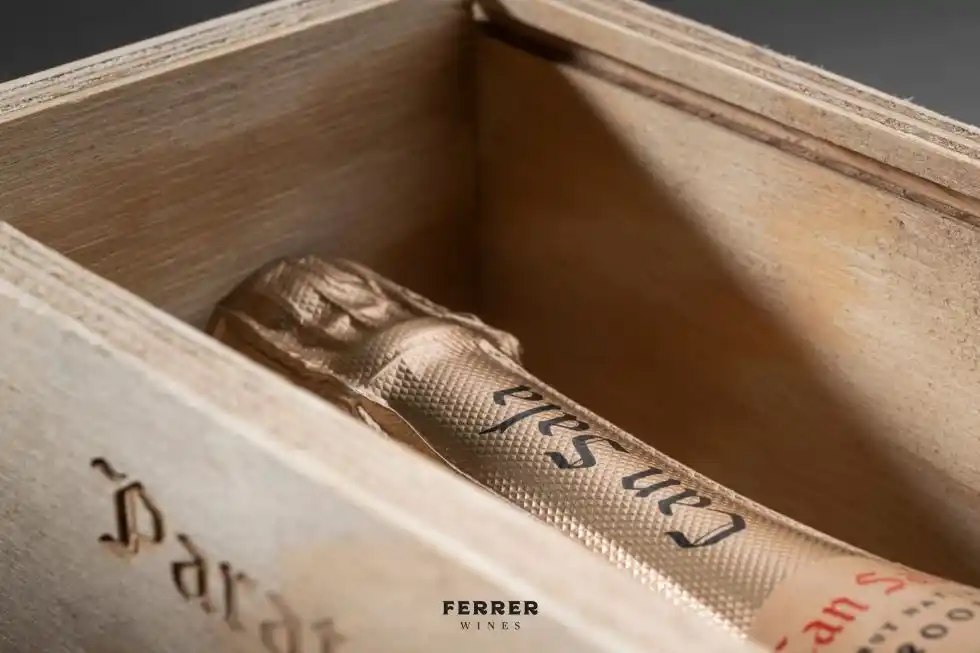
The Panot Gaudí collection is the meeting point between those two realities. Three cavas with their own character, made from organic grapes from the Alt Penedès and a label that reinterprets the geometry of the original tile. Three different proposals for different situations, united by the same philosophy: doing things well, without shortcuts, with the respect owed both to the winemaking tradition and to the symbol that gives them their name.
Three cavas, three moments
The
Panot Gaudí Brut Reserva is the most versatile proposal in the collection. An organic Cava de Guarda Superior, made from Xarel·lo, Macabeo and Parellada with a minimum ageing of 18 months on lees. Fresh, balanced, with a fine bubble and aromas of white fruit and citrus that make it suitable for almost any occasion. A cava that needs no excuse to appear on the table.
The
Panot Gaudí Gran Reserva is for those who want to go a step further. The longer ageing adds additional complexity that translates into greater creaminess, more evolved aromas and a more persistent and deeper finish. It is the cava in the collection that most rewards patience: both the winemaker’s patience in crafting it and the drinker’s patience in uncorking it.
The
Panot Gaudí Pinot Noir breaks the mould. Pinot Noir is not a common variety in cava, but in the hands of Cavas Hill it finds its place with a naturalness that surprises. More floral, more fruity, with a structure different from that of classic cavas. The perfect choice for those who want to step outside the familiar without moving away from quality.
A tribute you can drink
There are many ways to pay tribute to a symbol. You can frame it, photograph it, reproduce it on a T-shirt. We have chosen to drink it. Because it seems to us the most honest and coherent way with what we are: a winery that has spent more than 130 years turning territory into wine.
The panot teaches us that greatness does not require monumentality. That something can be small, functional and everyday and at the same time full of history, art and identity. Our cavas aspire to the same: to be present in the moments that matter, without seeking the spotlight, contributing exactly what is needed on each occasion.
Discover the full collection inspired by the
Panot de Barcelona and find the cava that best suits what you are looking for.